Checklist · Marketplace · Go-live
New marketplace integration checklist (pre go-live)
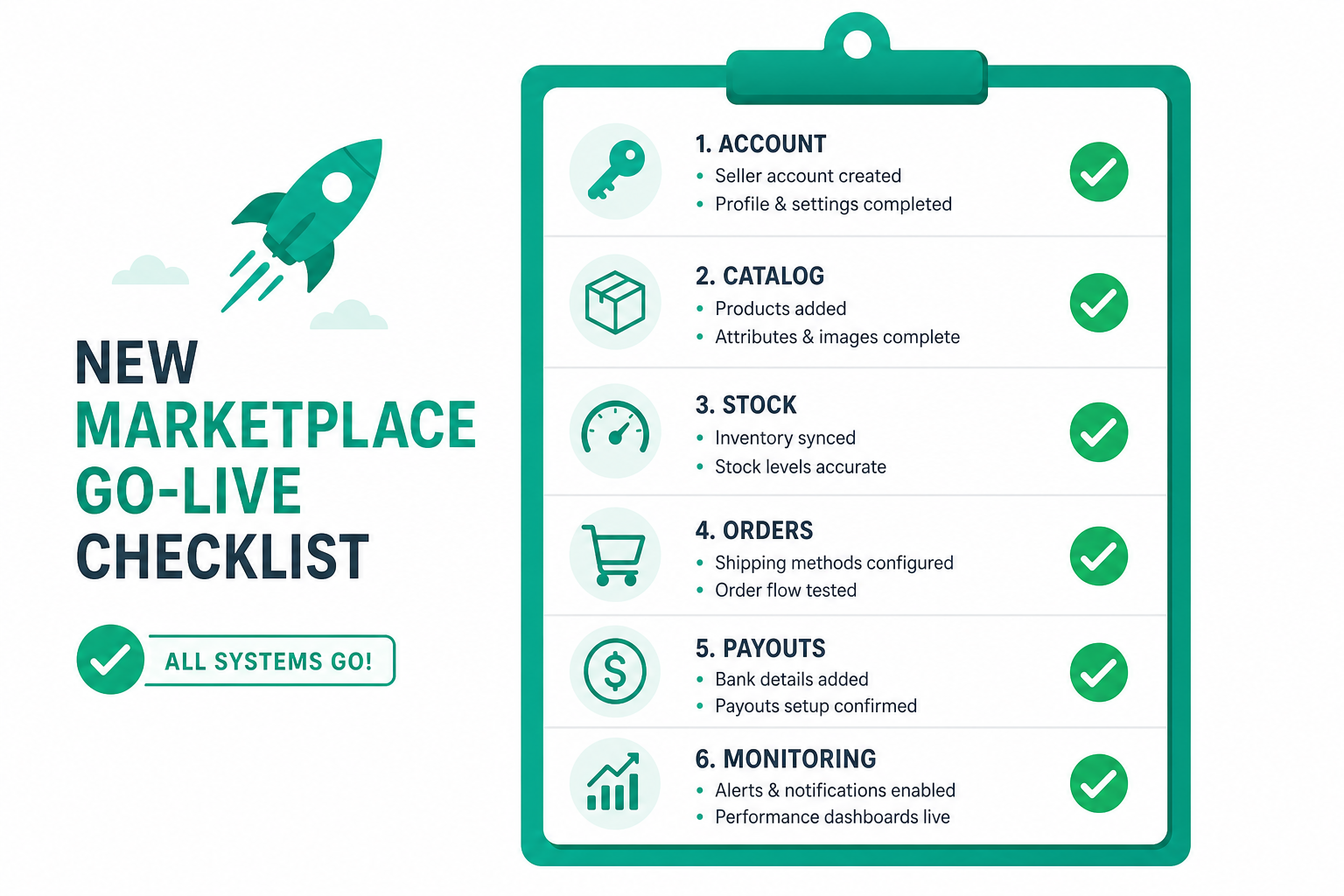
Integrating a new marketplace is not just "connecting the API". Before go-live there are many points that, if neglected, cause publication errors, overselling or accounting problems. This checklist gathers the essential controls.
1. Account and credentials
- active, verified seller account;
- application registered and authorised (OAuth);
- refresh token stored securely (e.g. Key Vault) and renewal tested;
- separate environments for test and production.
2. Policies and prerequisites
- payment, return and shipping policies configured;
- handling times and commercial terms defined;
- marketplace regulatory and tax requirements verified.
3. Catalog and mapping
- internal-to-marketplace category mapping;
- mandatory attributes covered for the categories used;
- product identifiers (GTIN/MPN) correct and validated;
- images compliant with the channel's requirements;
- variants modelled correctly.
4. Stock and prices
| Check | Why |
|---|---|
| Safety buffer | Prevent overselling on slow channels |
| Per-channel price list | Correct prices for currency and rules |
| Incremental updates | Fast propagation of stock and prices |
5. Orders and fulfillment
- idempotent order import (no duplicates);
- order status mapping to ERP/warehouse;
- tracking push tested, including partial shipments;
- returns and refunds handling.
6. Finances
- reading transactions and payouts;
- reconciliation between orders, fees and credits;
- mapping to accounting accounts/reasons.
7. Robustness
- retry with backoff and rate-limit handling;
- queues and dead-letter for failures;
- idempotency on all critical operations.
8. Monitoring
- structured logs with correlation IDs;
- business metrics (orders, sync, disapprovals);
- actionable alerts (dead-letter, API errors, missing orders);
- a dashboard for flow health.
9. End-to-end testing
- publishing real products in a sandbox or on a small set;
- full cycle: publication → order → shipment → payout;
- testing error scenarios and retries.
Conclusion
A successful go-live is not luck: it is the result of systematic checks on account, policies, catalog, stock, orders, finances, robustness and monitoring. Using this checklist before going to production drastically reduces problems in the first weeks, when they cost the most.