E-commerce and marketplace integration glossary (ERP, PIM, feed, API)
Last updated: June 2026·9 min read·Beginner
The essential e-commerce and marketplace integration terms, explained clearly.
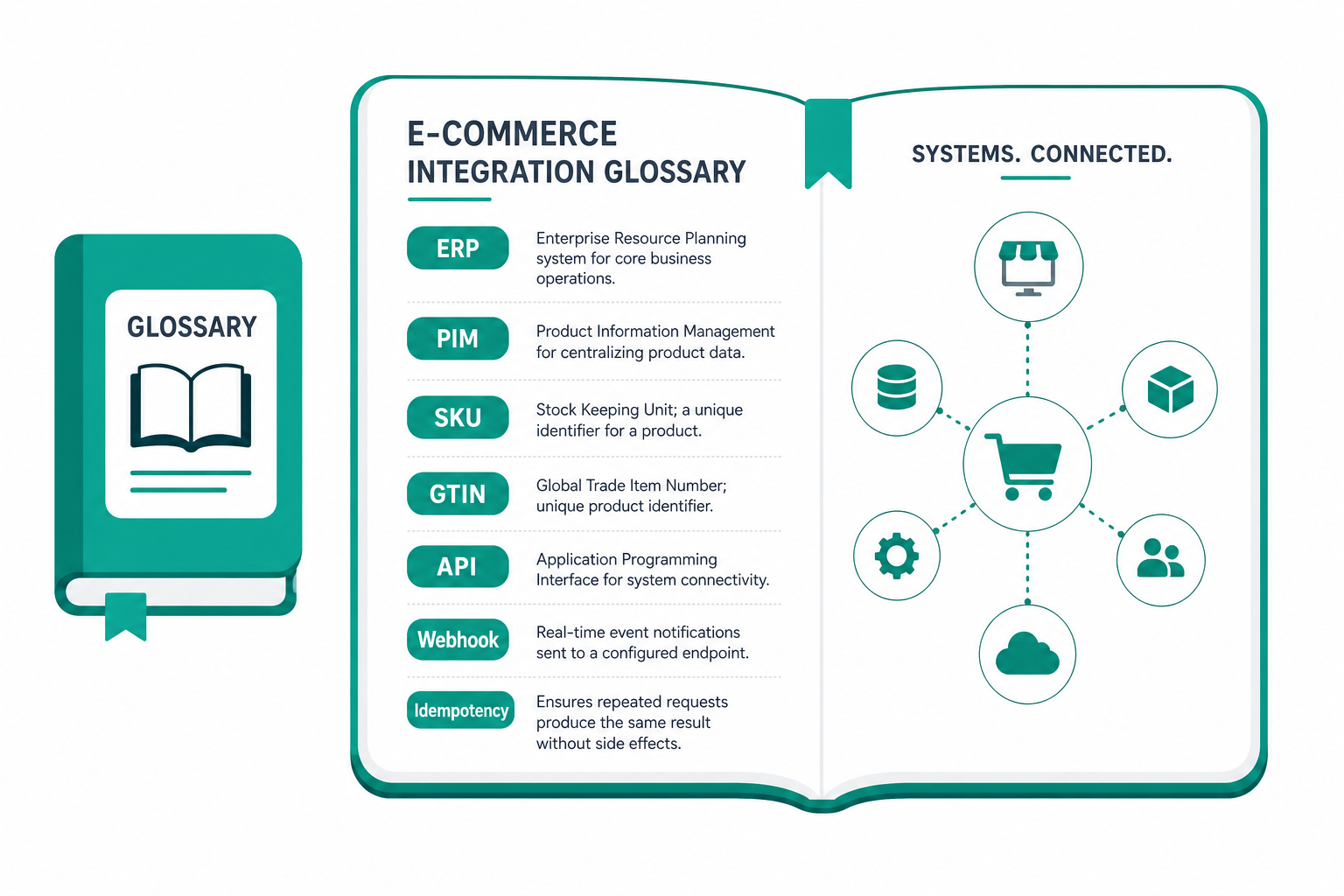
E-commerce integrations are full of acronyms and technical terms. This glossary collects the concepts that recur in every multichannel project, explained clearly and with concrete examples.
Systems and roles
Term
Meaning
ERP
Back-office system: orders, warehouse, accounting. Often the authoritative data source.
Manufacturer Part Number: used when a GTIN is missing.
Variant
A version of a product for options like size or colour.
Feed
A file or stream describing products for a channel.
System-to-system communication
Term
Meaning
API
Interface that lets software exchange data.
REST
Resource- and HTTP-based API style, typically with JSON.
Webhook
A push notification sent by a system when an event occurs.
Polling
Periodic querying to check whether anything is new.
OAuth
Token-based authorisation standard.
Reliability and resilience
Term
Meaning
Idempotency
Repeating an operation yields the same result, with no duplicates.
Rate limit
The number of calls allowed within a time window.
Backoff
Increasing wait between attempts after an error.
Dead-letter
Queue of messages that could not be processed successfully.
Reconciliation
Comparing data across systems to verify consistency.
Data and synchronisation
Term
Meaning
Delta
Only what changed compared to the previous state.
Bulk
A mass operation on many items at once.
Mapping
Correspondence between fields/categories of different systems.
Overselling
Selling more units than available in stock.
Stock buffer
Safety margin to prevent overselling.
Conclusion
Mastering these terms makes it easier to design, communicate and evaluate an integration. They are the shared vocabulary of those working between ERP, e-commerce and marketplaces: a common language reduces errors and misunderstandings in multichannel projects.