EPR · Compliance · Marketplace
EPR numbers for marketplaces: LUCID, WEEE and UIN to avoid suppression
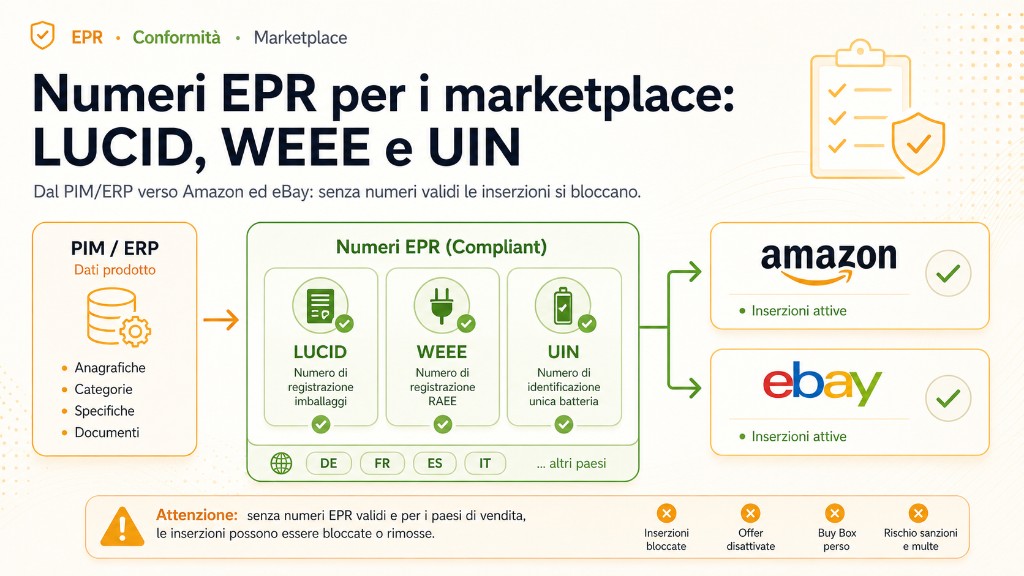
EPR (Extended Producer Responsibility) requires sellers in the EU to register with the relevant compliance schemes and to provide their registration numbers. For online sellers the practical point is blunt: without valid EPR numbers for the market, Amazon and eBay block or suppress listings. This is a technical guide on which numbers you need and how to provide them, not legal advice.
What EPR numbers are
They are identifiers issued by registers or compliance schemes (PROs) per product category: packaging, electrical equipment (WEEE), batteries, textiles and others. You must obtain them for each market you sell in, because the rules are national.
The main ones by market
| Market | Number | Scope |
|---|---|---|
| Germany | LUCID | Packaging (VerpackG register) |
| Germany | WEEE reg. no. | Electrical/electronic equipment |
| France | UIN (Identifiant Unique) | Per category, via a PRO such as Citeo |
On top of these come batteries, textiles and other categories depending on your catalog and country.
How to provide them to marketplaces
- Amazon: in the Compliance/Account Health portal of Seller Central or via the SP-API; without valid numbers, listings in the affected categories are blocked;
- eBay and other channels: analogous fields for the producer's registration numbers;
- feeds: where supported, the numbers are mapped into feed attributes alongside the other compliance data.
Curate the data at the source
As with other attributes, keep EPR numbers as structured data in the PIM/ERP (per manufacturer and per market) and map them to each channel instead of entering them by hand. It's the same approach as the mandatory GPSR fields in feeds and plugs into the logic of feed attribute optimisation. Add the EPR numbers check to your new marketplace integration checklist.
What happens when they're missing
On marketplaces that enforce it the result is immediate: blocked or unpublishable listings in the affected categories, with continuous monitoring. It's a "silent" problem: the technical integration works, but products don't go live because a registration number is missing.
Common mistakes
- registering in one country and forgetting the other active markets;
- treating the numbers as free text instead of per-market/category data;
- not updating marketplaces when adding categories or countries;
- discovering the obligation only when listings get blocked.
Conclusion
From an integration standpoint, EPR is a data and per-market mapping problem: obtain the numbers from the registers, keep them in the PIM and provide them to every channel. The regulatory responsibility stays with the seller: this guide covers the technical side. References: the German register LUCID and the French PRO Citeo.