Feed · Attributes · Visibility
Product feed optimization: attributes that boost visibility
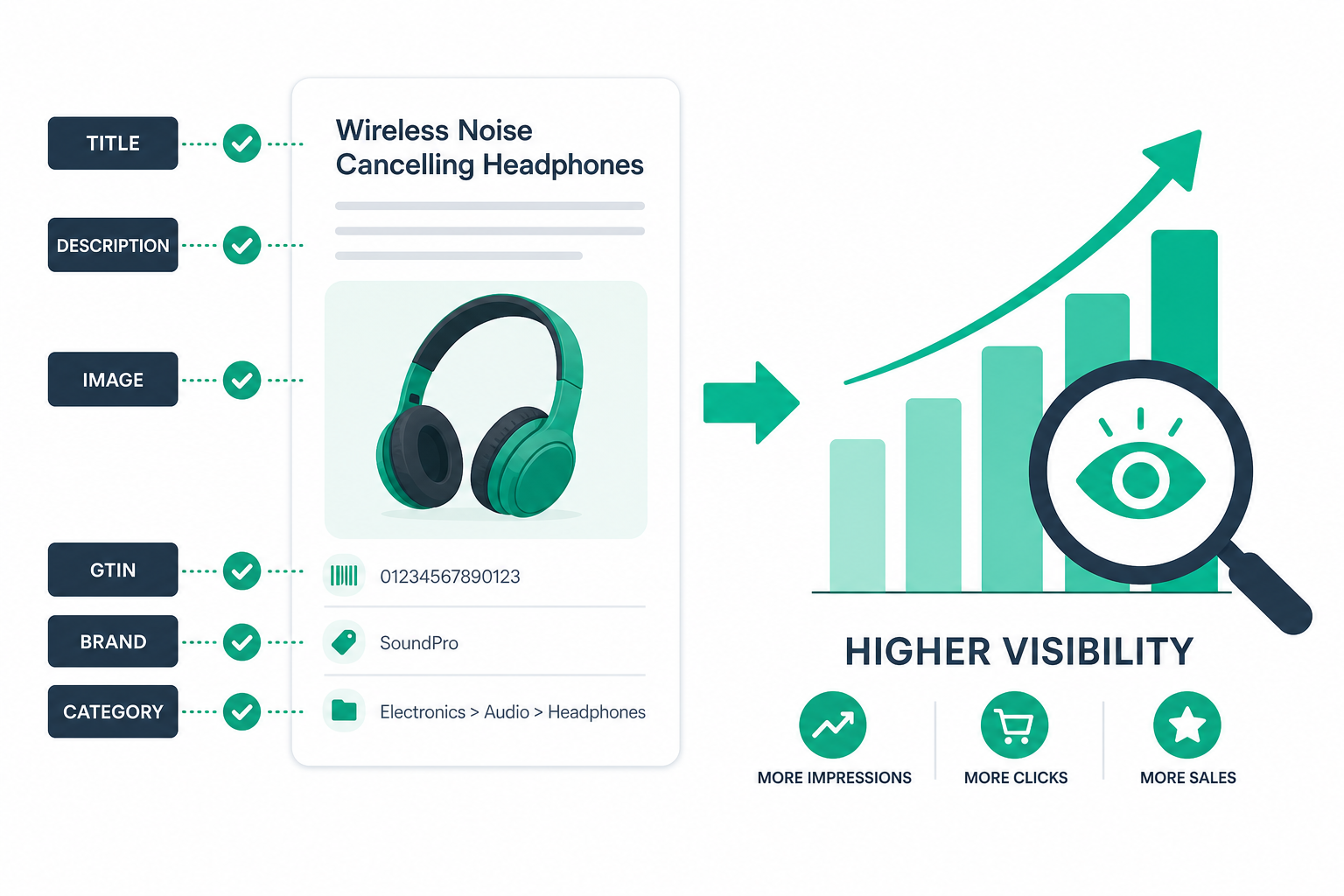
A technically valid product feed can still perform poorly. The difference between products that show up and products that stay invisible lies in attribute quality. Optimising the feed means taking care of the fields that engines use to understand and surface products.
The title: the most important field
The title is the strongest relevance signal. Build it to be informative and predictable, not as a slogan:
- put the things users search for first: brand, model, type;
- include distinctive attributes (size, colour, capacity) when relevant;
- avoid excessive caps, symbols and promotional text.
A repeatable formula (e.g. Brand + Product type + Key attributes + Model) generated from PIM attributes scales better than hand-written titles.
Description, images and identifiers
| Attribute | What to get right |
|---|---|
| description | Complete, factual, with features and materials |
| image_link | Clean main image, high resolution, neutral background |
| gtin / mpn | Correct identifiers for product matching |
| brand | Brand consistent with the official catalog |
| google_product_category | Correct category for the right context |
Attributes that widen coverage
Some fields are not mandatory but unlock features and filters:
color,size,gender,age_groupfor fashion;product_highlightsfor key selling points;sale_priceand dates for promotions;shippingandtaxwhen the channel requires them.
Fix data at the source
The golden rule: optimise in the PIM/ERP, not in the feed. Changes made directly on the feed are fragile and not reusable across channels. Improving attributes at the source benefits all channels at once and keeps data consistent.
Measure and iterate
Optimisation is a loop: measure attribute coverage, find weak products, enrich them and measure again. Keep an eye on products without GTIN, without a valid image, with too-short titles or with the wrong category.
Common mistakes
- promotional titles instead of informative ones;
- images with watermarks, text or noisy backgrounds;
- missing or invented identifiers;
- a category that is too generic or wrong.
Conclusion
Optimising the feed is not "gaming" the data, but making it clear and complete for engines. Informative titles, clean images, correct identifiers and rich attributes, curated at the source, are what turns a catalog into visible products. Useful reference: Product data specification (Google).