GPSR · Feed · Compliance
GPSR: the mandatory fields to add to product feeds (EU)
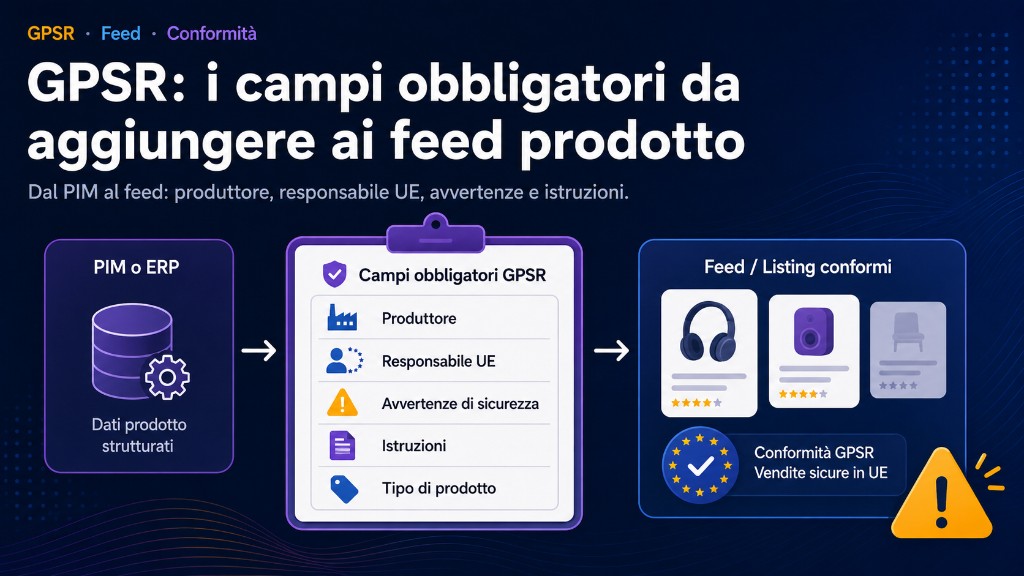
The GPSR (General Product Safety Regulation) has applied across the European Union since 13 December 2024. For online sellers the practical point is one: every listing for a product aimed at EU consumers must display a set of mandatory pieces of information. When they're missing, marketplaces like Amazon suppress the listings. This is a technical guide on which fields you need and how to inject them into feeds — not legal advice.
What the GPSR requires in listings
The baseline rule: a product cannot be placed on the EU market without an economic operator established in the Union (the "responsible person") and without the listing showing who the manufacturer is and how to contact them. The information must be visible to the consumer before purchase.
The mandatory fields
| Field | Content |
|---|---|
| Manufacturer | Manufacturer's name, postal address and email |
| EU responsible person | Name and contact of the economic operator established in the EU (if the manufacturer is outside the EU) |
| Product identifiers | Type, batch/serial number or other identifier (in addition to GTIN/MPN) |
| Warnings and safety | Relevant warnings, instructions and safety information |
Where the data lands: feeds and marketplaces
- Google: dedicated attributes (manufacturer and EU responsible person) are populated from the product feed;
- Amazon: the "EU Responsible Person" is mandatory by category; without a valid responsible person, listings in the affected categories are suppressed;
- eBay and other channels: provide analogous fields for manufacturer and responsible person, to be filled for the EU market.
Curate the data at the source and inject it into the feed
The same golden rule as feed optimisation applies: fix the data in the PIM/ERP, not in the individual feed. Keep manufacturer, EU responsible person and warnings as structured attributes in the catalog, then map them onto the fields each channel requires. This is exactly the mapping layer described in how to optimise feed attributes, and it plugs into the same pipeline shown in syncing the feed to Google Merchant Center. Identifiers (GTIN/MPN) follow the same logic as handling variants and GTINs in feeds.
Shop-wide or per listing?
Many channels let you set the EU responsible person at the account/shop level, applying it to all EU listings at once instead of filling it product by product. Use it for the constant data (responsible person, manufacturer) and handle per-product only what varies (specific warnings, identifiers).
What happens when the data is missing
On marketplaces that enforce it, the result is immediate and concrete: suppressed or unpublishable listings in the categories subject to the obligation, with continuous monitoring. It's a "silent" problem: the technical integration works, but the products don't show because a compliance attribute is missing.
Common mistakes
- treating GPSR as a free-text field instead of structured, mappable attributes;
- filling the responsible person for a few products and forgetting it on new listings;
- curating the data directly in the feed instead of the PIM (fragile and not reusable across channels);
- ignoring that each marketplace has slightly different field names and rules.
Conclusion
From an integration standpoint, GPSR is a data and mapping problem: a few extra attributes, curated at the source and injected correctly into every feed, make the difference between visible products and suppressed listings. The regulatory responsibility stays with the seller: this guide covers the technical side. Official reference: GPSR — European Commission.