ERP · PIM · Middleware
ERP, PIM and middleware: which one do you need for multichannel?
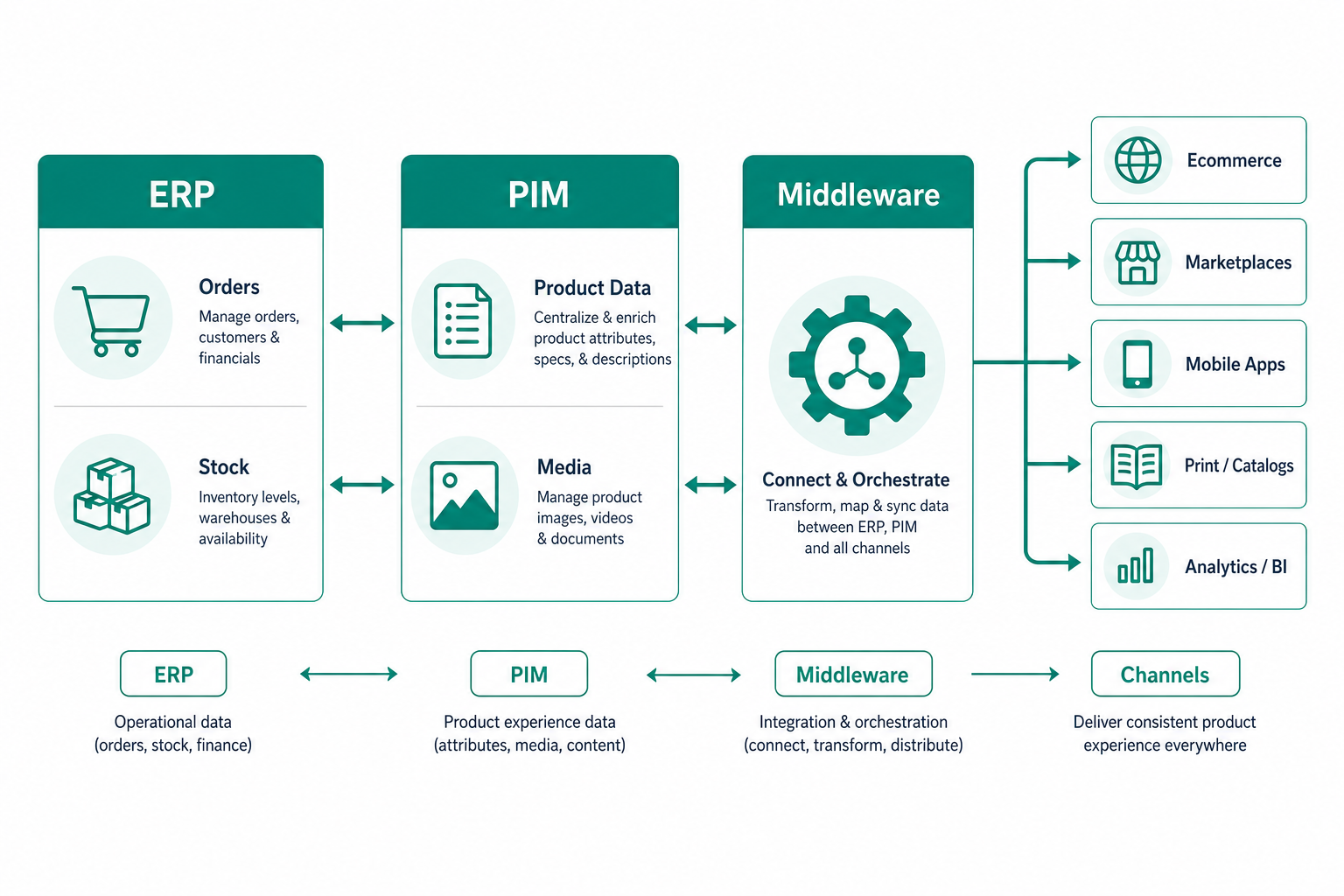
When it comes to selling on multiple channels, three acronyms keep coming up: ERP, PIM and middleware. They are often confused or conflated. Understanding what each does and who owns which data is the foundation of a clean architecture.
ERP: the operational truth
The ERP manages orders, warehouse, purchasing, invoicing and accounting. It is typically the authoritative source for stock, base prices and commercial master data. It is not, however, designed to manage rich product pages and marketing content.
PIM: product quality
The PIM (Product Information Management) manages attributes, descriptions, translations, images and relationships between products. It is the authoritative source for the product content to publish across channels. It becomes valuable when products are many, multilingual or attribute-rich.
Middleware: translation and orchestration
The middleware (or integration layer) connects systems: it reads from ERP and PIM, applies mapping and rules, talks to marketplaces and e-commerce, handles events, retries and reconciliation. It does not "own" business data: it orchestrates and translates it.
Who owns what
| Data | Typical authoritative source |
|---|---|
| Stock and inventory | ERP |
| Base price | ERP |
| Product attributes and content | PIM |
| Media (images, video) | PIM |
| Orders | ERP (often via OMS/middleware) |
| Per-channel mapping and rules | Middleware |
Defining a single authoritative source for each piece of data avoids conflicts and overwrites: it is the single source of truth principle.
Which one do you actually need?
- ERP only: may be enough with few simple products and a single channel;
- ERP + middleware: needed as soon as channels increase;
- ERP + PIM + middleware: ideal with rich, multilingual catalogs and many channels.
It is not a contest: the three components complement each other. The right question is not "which one", but "which role do I assign to each".
Common mistakes
- using the ERP as a PIM, filling it with content it cannot manage;
- no clear authoritative source, with data overwriting each other;
- middleware becoming a data store instead of an orchestrator;
- duplicating channel rules across multiple systems.
Conclusion
ERP, PIM and middleware are not alternatives but complementary roles: the ERP for operational truth, the PIM for product content, the middleware for translation and orchestration. Giving each a clear responsibility is what makes a multichannel architecture scalable and free of duplication.