eBay · API · Comparison
eBay Sell API vs Trading API: which to choose in 2026
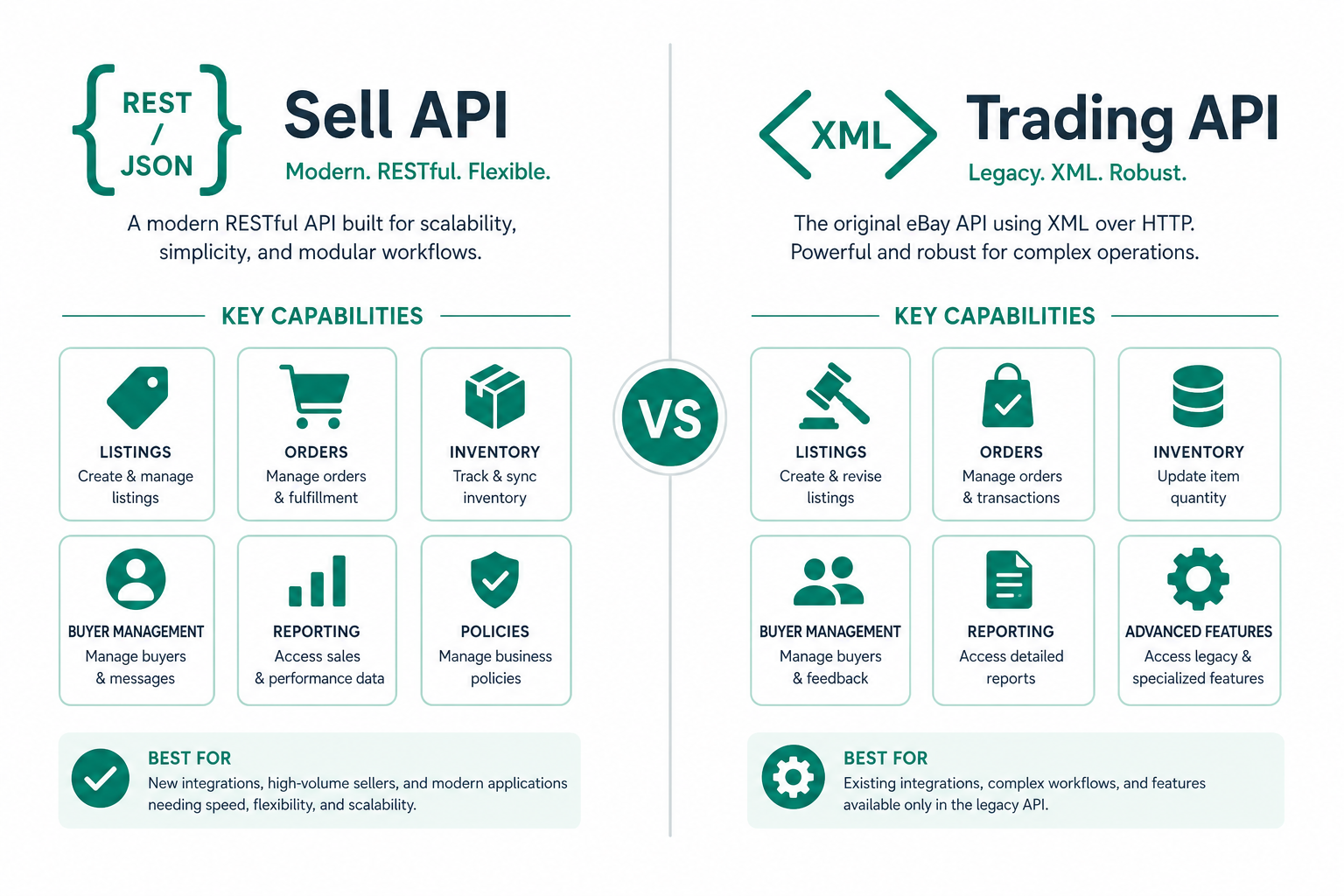
Anyone starting an eBay integration faces a choice early on: use the modern Sell API (REST) or the historical Trading API (XML). It is not an ideological question: it depends on the project, the feature coverage and your starting point.
The two families at a glance
The Sell API is a set of REST APIs organised by functional area (Inventory, Fulfillment, Finances, Account, Metadata, Marketing, Analytics). The Trading API is the previous generation, XML-based, with many operational calls inherited from years of marketplace evolution.
Head-to-head comparison
| Aspect | Sell API | Trading API |
|---|---|---|
| Protocol | REST, JSON | XML, SOAP/POST-oriented |
| Model | Functional areas, resources | Operational calls |
| Inventory | SKU, inventory item, offer | Item-centric |
| Maintainability | High for new projects | Good if already in use |
| Best for | Modern cloud integrations | Legacy systems and uncovered cases |
When to choose the Sell API
- new projects starting from ERP/PIM with structured data;
- SKU-based flows with incremental stock and price updates;
- cloud architectures, microservices, JSON payloads;
- the need for financial reconciliation with the Finances API.
When the Trading API still makes sense
- existing integrations already built on XML that work well;
- specific features not yet covered by the Sell API;
- edge cases of categories or aspects historically handled via Trading.
Gradual migration, not big bang
In practice, migration is rarely total and immediate. The sensible approach is incremental:
- introduce the Sell API for new areas (inventory, finances);
- keep the Trading API where it covers cases not yet available;
- isolate calls behind an abstraction layer, so the rest of the system does not depend on the underlying API;
- move features over progressively as coverage grows.
The choice in 2026
For a new project, in 2026 the Sell API is the natural choice: a cleaner model, JSON, well-separated areas and better alignment with cloud architectures such as Azure. The Trading API remains a useful resource for legacy cases and to cover niche features during the transition.
Conclusion
It is not "old versus new", but choosing the right tool for the context. The rule of thumb: Sell API for the new, Trading API where still needed, all behind a layer that makes migration painless. Official documentation: eBay Sell API — Overview.