eBay · Integration · Pitfalls
Common eBay integration mistakes (and how to avoid them)
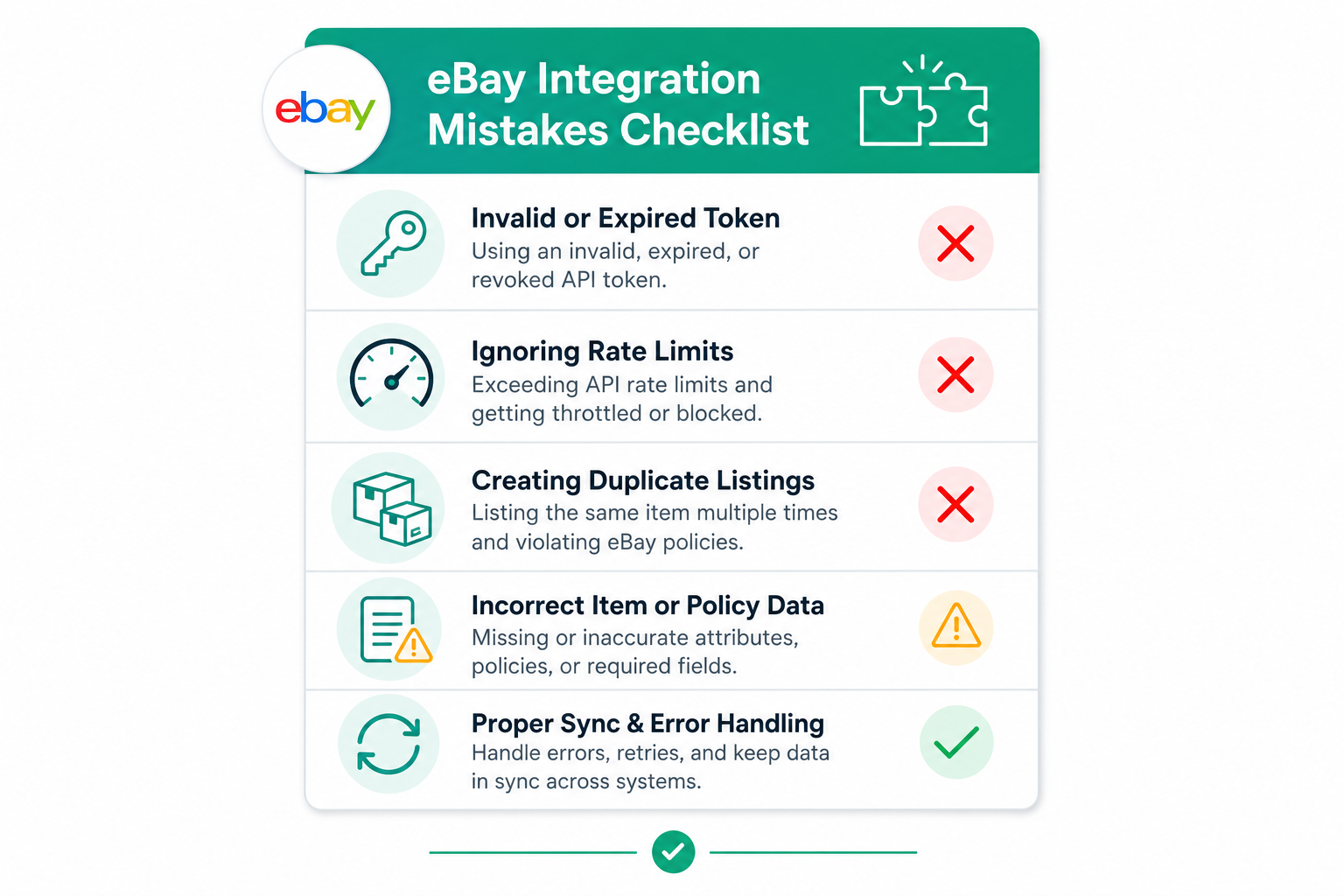
eBay integrations rarely fail because of "the wrong call" and almost always because of structural bad habits: token handling, API limits, validation, idempotency. Here are the mistakes we see most often and how to avoid them.
1. Treating the Sell API as a "publish" button
The Sell API is not a "put it on eBay" button: it is an integration layer between internal systems and the marketplace. Thinking of it that way leads to skipping account, policies, validation and reconciliation. Fix: design the full flow, not just publication.
2. Mishandling OAuth tokens
Access tokens expire and refresh tokens must be stored securely. Hardcoding credentials or not renewing tokens causes intermittent 401 errors. Fix: centralise secrets (e.g. Azure Key Vault), renew tokens before expiry and handle refresh in a concurrency-safe way.
3. Ignoring rate limits
eBay applies call limits. Ignoring them causes errors and, in the worst cases, temporary blocks. Fix: client-side throttling, exponential backoff with jitter and explicit handling of limit responses.
4. No idempotency
Without idempotent keys, a retry creates duplicate orders, duplicate tracking, duplicate postings. Fix: use unique identifiers (orderId, transactionId, SKU) as keys and make every operation repeatable without side effects.
5. Skipping pre-publication validation
Publishing without checking category, mandatory aspects, product identifiers and policies leads to downstream errors that are hard to diagnose. Fix: validate data with Metadata before calling publishOffer.
6. Seller account not ready
Missing payment, return or fulfillment policies compatible with the category cause publication to fail. Fix: verify account readiness during onboarding and surface clear errors.
7. Confusing orders and cash-ins
An order is not a payout: fees and refunds change the amount. Fix: use the Finances API and reconcile transactions against payouts.
8. Synchronous, fragile flows
Calling APIs inline with the user or warehouse action makes the system fragile under spikes. Fix: queues, workers and asynchronous processes with retries.
9. No monitoring
Without structured logs and alerts, errors are discovered from negative feedback. Fix: logs with correlation IDs, business metrics and alerts on anomalies.
10. Syncing everything, always
Sending the whole catalog every cycle saturates the API. Fix: work in deltas and use bulk operations only where needed.
Conclusion
Almost all these mistakes share the same root: treating the integration as a script instead of a system. Tokens, limits, idempotency, validation and monitoring are not details: they are what makes an eBay integration reliable over time. Official documentation: eBay Sell API — Overview.