Azure · Functions · Service Bus
Azure Functions + Service Bus for marketplace order ingestion
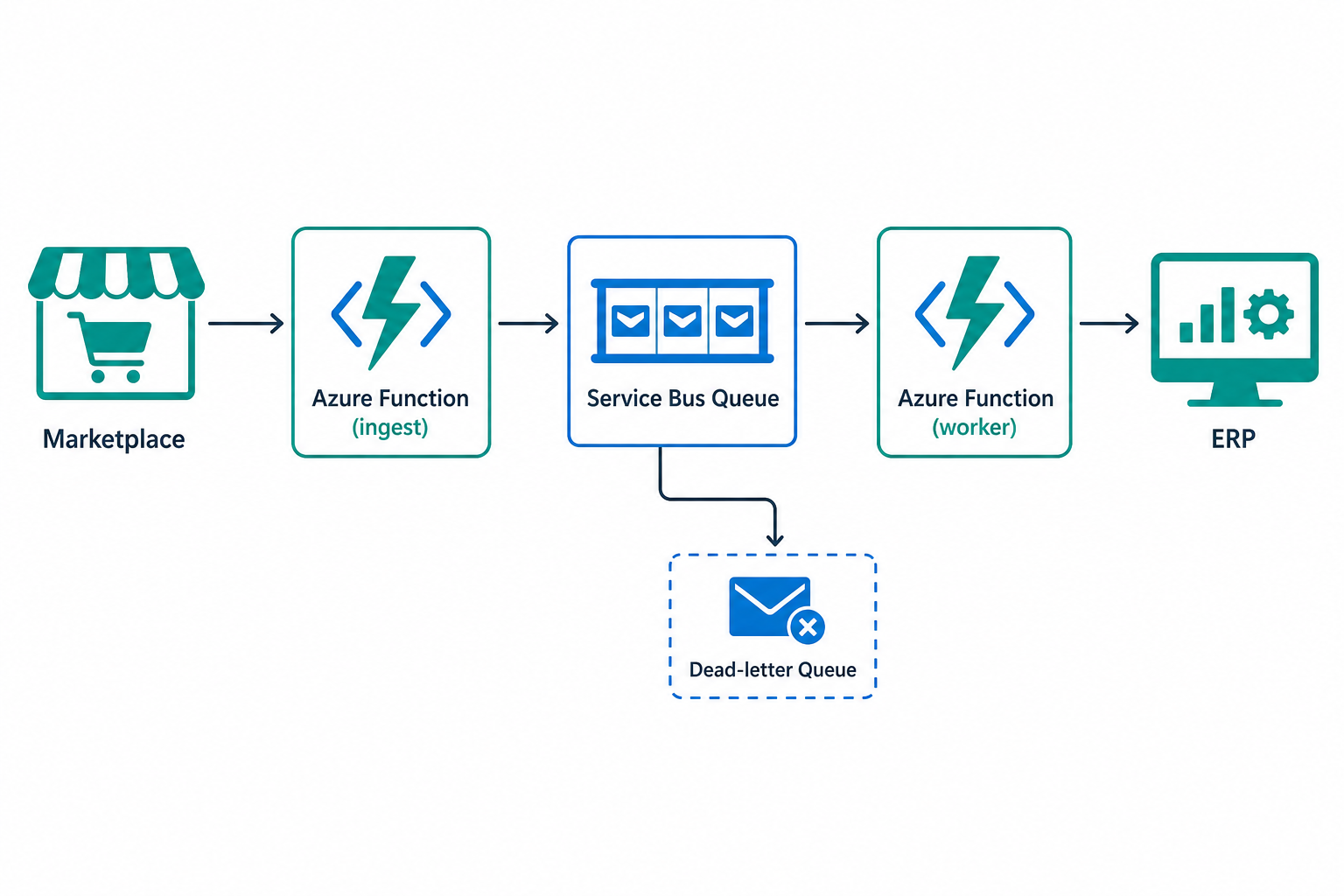
Ingesting marketplace orders looks simple while volumes are low. Under load, or when a downstream system is slow, a synchronous pipeline collapses. The Azure Functions + Service Bus combination is a proven pattern to receive and process orders reliably and at scale.
Why decouple ingestion from processing
Separating "receive" from "process" brings three benefits: absorbing spikes without losing data, safely retrying transient failures and scaling the two sides independently. Service Bus acts as a durable buffer, Functions as elastic compute.
The components
| Component | Role |
|---|---|
| Function (ingestion) | Receives the order (polling or webhook) and enqueues it |
| Service Bus queue/topic | Durable buffer, dead-letter, sessions |
| Function (worker) | Consumes messages, syncs ERP/warehouse |
| Database | State, dedup, logs |
Idempotency and dedup
A message can be delivered more than once. The rule is at-least-once + idempotency: use orderId as the key and make processing repeatable. Service Bus also offers native deduplication based on MessageId within a time window.
Guaranteed ordering with sessions
If the same order or customer needs sequential processing, use Service Bus sessions: messages with the same session id are processed in order by a single consumer at a time, avoiding race conditions on status updates.
Failure handling: dead-letter
Messages that fail repeatedly land in the dead-letter queue instead of blocking the main queue. From there you can analyse, fix and reprocess them. It is essential to set a maximum number of attempts and monitor the dead-letter with alerts.
Scaling consumers
Functions scale with queue depth: more messages, more instances. But control concurrency towards downstream systems (ERP, marketplace APIs) so you do not saturate them: cap parallelism and combine with rate-limit patterns.
Common mistakes
- synchronous processing with no buffer, fragile under spikes;
- no idempotency with at-least-once delivery;
- dead-letter ignored and messages effectively lost;
- unbounded concurrency that saturates ERP and APIs.
Conclusion
Azure Functions and Service Bus provide the building blocks for robust order ingestion: durable buffer, idempotency, ordering with sessions, dead-letter and controlled scaling. It is the backbone of a pipeline that holds up to real multichannel volumes. Reference: Azure Service Bus (Microsoft Learn).